
Technical Proposal for PV Energy Storage Power Supply System for Duplex House in Nigeria
Preface
The public power grid in Nigeria suffers from poor stability and frequent power outages. Diesel generators are associated with high operation and maintenance costs, loud noise and severe pollution. Households in duplex residences have strong demand for stable and uninterrupted power supply. This project builds a PV-storage integrated power supply system for local duplex houses. Solar power is generated and stored by utilizing rooftop PV resources, reducing reliance on the public grid and diesel generators.
The system is equipped with 14 pieces of 650W PV modules, a 6kW hybrid inverter, and a vertical low-voltage lithium battery pack with a total capacity of 32kWh. The PV array adopts a wiring scheme of 2 parallel strings with 7 modules per string. The designed daily power generation of the system is 45 kWh, and the daily stored electricity is 32 kWh. Balancing safety, power backup duration and equipment service life, the system realizes self-consumption of on-site solar power and backup power supply during grid outages. It can meet the power demand of household lighting, refrigerators, televisions, fans and other major domestic appliances. This proposal fully describes the system configuration, equipment parameters, operating principle and load capacity.
1. Overview of Overall System Configuration
This PV energy storage system is designed for duplex houses in Nigeria. The photovoltaic power generation unit consists of 14 pieces of 650W PV modules. The energy storage unit is configured with 2 sets of 16kWh vertical low-voltage lithium batteries, with a total energy storage capacity of 32kWh. The core control unit adopts a 6kW hybrid inverter integrating MPPT charging, inverter output and battery management functions.
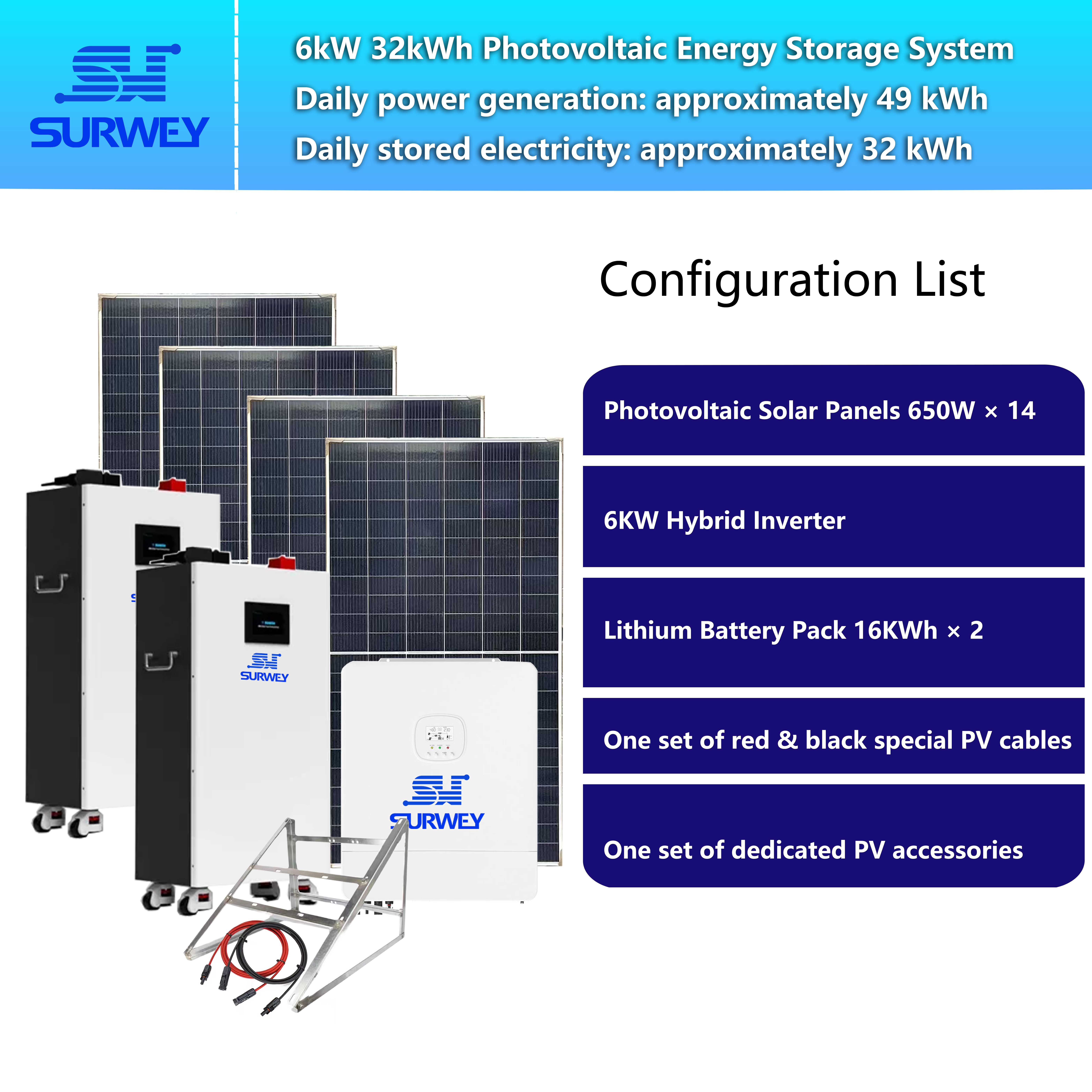 System Configuration Diagram
The system is designed to generate 45 kWh of electricity per day. After covering direct household power consumption in daytime, 32 kWh of surplus electricity can be stored in lithium batteries for use at night and during power outages. The system supports both grid-tied and off-grid backup operating modes, adapting to the local environment of severe grid fluctuation and frequent power cuts.
2. Main Equipment Parameters of the Project
(1) 650W PV Module
High-efficiency monocrystalline PV modules, 14 pieces in total, single module power 650W, total installed capacity 9.1kWp. It features excellent high-temperature output performance, suitable for the hot climate in Nigeria. The modules are wind and hail resistant for rooftop open-air installation. The string voltage and current fall within the allowable input range of the inverter, ensuring stable maximum power tracking by the MPPT module to improve power generation yield. The modules have outstanding weather resistance and long service life, adapting to tropical outdoor conditions with intense sunlight and heavy rainfall. The surface dust-proof coating facilitates later cleaning and maintenance, mitigating power generation efficiency degradation caused by sand and dust.
(2) 6kW Hybrid Inverter

As the core equipment of the system, this hybrid inverter integrates MPPT PV charging, battery charge-discharge management and AC inverter output functions. It is equipped with multiple safety protections including overload protection, ground fault monitoring and insulation monitoring. It supports generator connection and intelligent load control, capable of 200% overload for 10 seconds to achieve reliable load starting capacity. Its protection grade allows outdoor installation. Users can view system operating data via display screen and mobile APP. It supports switching between off-grid backup and grid-tied modes, enabling automatic energy dispatching among PV, battery and mains power to guarantee continuous residential power supply. It can cope with the starting impact of inductive loads, suitable for the startup conditions of air conditioners and water pumps.
(3) 32kWh Vertical Low-Voltage Lithium Battery

The energy storage system with a total capacity of 32kWh is composed of 2 sets of 16kWh vertical low-voltage lithium batteries. The vertical structure facilitates indoor placement and installation. Built-in BMS (Battery Management System), the battery has ≥8000 charge-discharge cycles, high charge-discharge efficiency and long service life. The battery communicates and interacts with the hybrid inverter to realize intelligent charge and discharge control, with protection functions against overcharge, overdischarge, overcurrent and abnormal temperature.

Indoor Battery Bank Installation
Surplus solar energy is stored in the battery during daytime for household power supply at night. It acts as a backup power source to guarantee basic domestic power consumption in case of grid blackout. Its long-cycle performance adapts to the local operating scenario of frequent charge and discharge cycles.
3. System Operating Principle
The whole system adopts the hybrid operating logic of self-consumption of solar power and surplus energy storage. Automatic scheduling is realized by the hybrid inverter without manual intervention.
Schematic Video of System Working Principle
On sunny days with sufficient sunlight, the 650W PV array captures solar energy and outputs DC power, which is transmitted to the MPPT module of the 6kW hybrid inverter. The MPPT tracks the maximum power point in real time. The electricity generated by PV is preferentially supplied to household loads to meet instant power demand for lighting and home appliances. When PV power output exceeds real-time household consumption, surplus power automatically charges the 32kWh lithium battery, achieving 32 kWh stored energy per day.
At night or on cloudy days with insufficient sunlight, PV power output drops or stops completely. The system switches automatically: the lithium battery releases stored DC power, which is converted into standard AC power by the hybrid inverter to supply household loads. When the public grid is available, the system can connect to the grid, and PV, battery and mains power work in coordination. Once grid failure occurs, the system switches to off-grid island mode within milliseconds, disconnecting the grid side circuit. The residence is continuously powered by PV and battery independently to avoid shutdown of household appliances. The system is equipped with complete protection logic. The battery BMS interlocks with inverter protections to trigger automatic shutdown under abnormal conditions, ensuring equipment and personal safety.
4. Available Load Power and Power Backup Duration
This 6kVA system can stably drive up to 3 air conditioners, water pumps, deep freezers and other basic household appliances. The rated output power of the hybrid inverter is 6kW. In backup mode, it supports 2 times rated power overload for 10 seconds to cope with the starting impact of inductive loads such as refrigerators and water pumps. Maximum continuous stable load: 6000W. Supported loads for duplex house: LED lighting in multiple rooms, refrigerators, fans, televisions, routers, washing machines, low-power air conditioners, water pumps, deep freezers and other equipment.
Reference Backup Power Duration
(Battery capacity: 32kWh, allowable depth of discharge of lithium iron phosphate battery: 80%, comprehensive system conversion efficiency: 90%)
- Light load 1200W (lighting, deep freezer, TV, network equipment): available energy ~23.04kWh, continuous operation for approx. 19 hours
- Medium load 2400W (adding fans, water pumps and partial small home appliances): continuous operation for approx. 9.5 hours
- High load 4500W (2 air conditioners + freezer + basic household equipment): continuous operation for approx. 5.1 hours
- Full load 6000W condition: continuous operation for approx. 3.8 hours
Note: The actual operating duration fluctuates subject to sunlight condition, initial battery SOC and actual power consumption of appliances. With solar power replenishment in daytime, the power supply duration will be further extended. When multiple air conditioners and water pumps start simultaneously, stagger their startup time to reduce instantaneous impact and ensure stable system operation.
5. Conclusion
This PV energy storage system adapts to the actual power consumption situation of duplex houses in Nigeria. 14 pieces of 650W PV modules are deployed with reasonable electrical configuration. The electrical parameters match the 6kW hybrid inverter, paired with the 32kWh long-cycle lithium battery. The system achieves 45 kWh daily power generation and 32 kWh daily surplus energy storage.
The system can greatly reduce the residence’s dependence on unstable public power grid and diesel generators. It provides long-duration backup power during outages and supports simultaneous operation of air conditioners, water pumps, deep freezers and various household devices to secure domestic power supply.
All equipment is well protected and suitable for the local tropical high-temperature outdoor environment. The system runs automatically with low operation and maintenance workload. In daily operation, it is recommended to clean dust on PV module surfaces regularly, inspect wiring terminals, and stagger startup of high-power equipment to ensure long-term stable power generation and energy storage, providing economical, clean and reliable power supply for the duplex house.


