
Technical Solution for PV-ESS System of Palm Oil Plantation Workshop, Sumatra
Technical Solution for PV-ESS System of Palm Oil Plantation Workshop in Sumatra
Preface
The workshop supporting the palm oil plantation on Sumatra Island is located in a remote tropical area with unreliable power supply from the public grid. The traditional diesel generator sets in the plant suffer from high fuel procurement costs, heavy maintenance workload, high noise and prominent carbon emissions. Lighting, security monitoring, ventilation and heat dissipation equipment, and small auxiliary processing equipment in the workshop require continuous power supply. Power outages will adversely affect basic production and security duty of the plant.
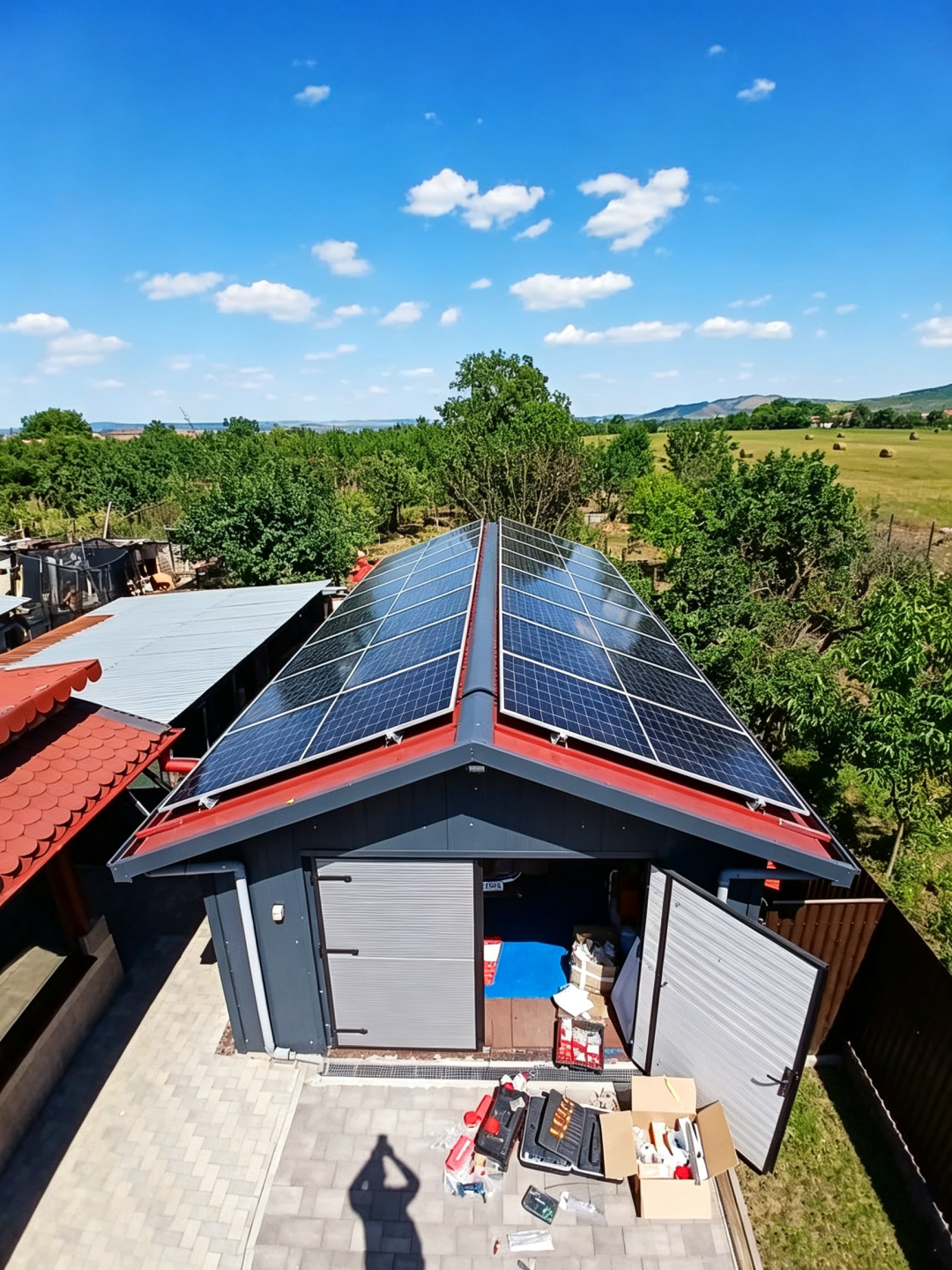
PV Array Layout on Workshop Roof
A photovoltaic energy storage integrated power supply system will be constructed for this project to fully utilize local solar irradiation resources. The system is equipped with 16 pieces of 600W PV modules, a 12kW hybrid inverter, and 2 sets of 15kWh mobile low-voltage lithium batteries. The designed daily power generation capacity is 48kWh, and the daily stored energy capacity is 30kWh. The system realizes self-consumption of PV power and reduces the operation frequency of diesel generators. All equipment is designed to adapt to the local tropical environment featuring high temperature, high humidity and heavy rainfall, with outdoor-compliant protection performance to guarantee long-term stable power supply for critical workshop loads.
1. Overall System Configuration
This PV-ESS system consists of three subsystems: photovoltaic power generation unit, hybrid inverter energy storage & inversion unit, and energy storage battery unit.

System Bill of Materials
The photovoltaic side includes 16 pieces of 600W PV modules. 8 modules are connected in series to form one string, with a total of 2 strings. The two strings are connected to two independent MPPT ports of the 12kW hybrid inverter respectively. For energy storage, 2 sets of 15kWh mobile low-voltage lithium batteries operate in parallel, delivering a total energy storage capacity of 30kWh. The system is designed to generate 48kWh power per day and store 30kWh energy per day. Solar power supplies workshop loads during daytime, and surplus power is stored in batteries. The storage batteries discharge to supply basic power demand of the plant at night and on cloudy/rainy days.
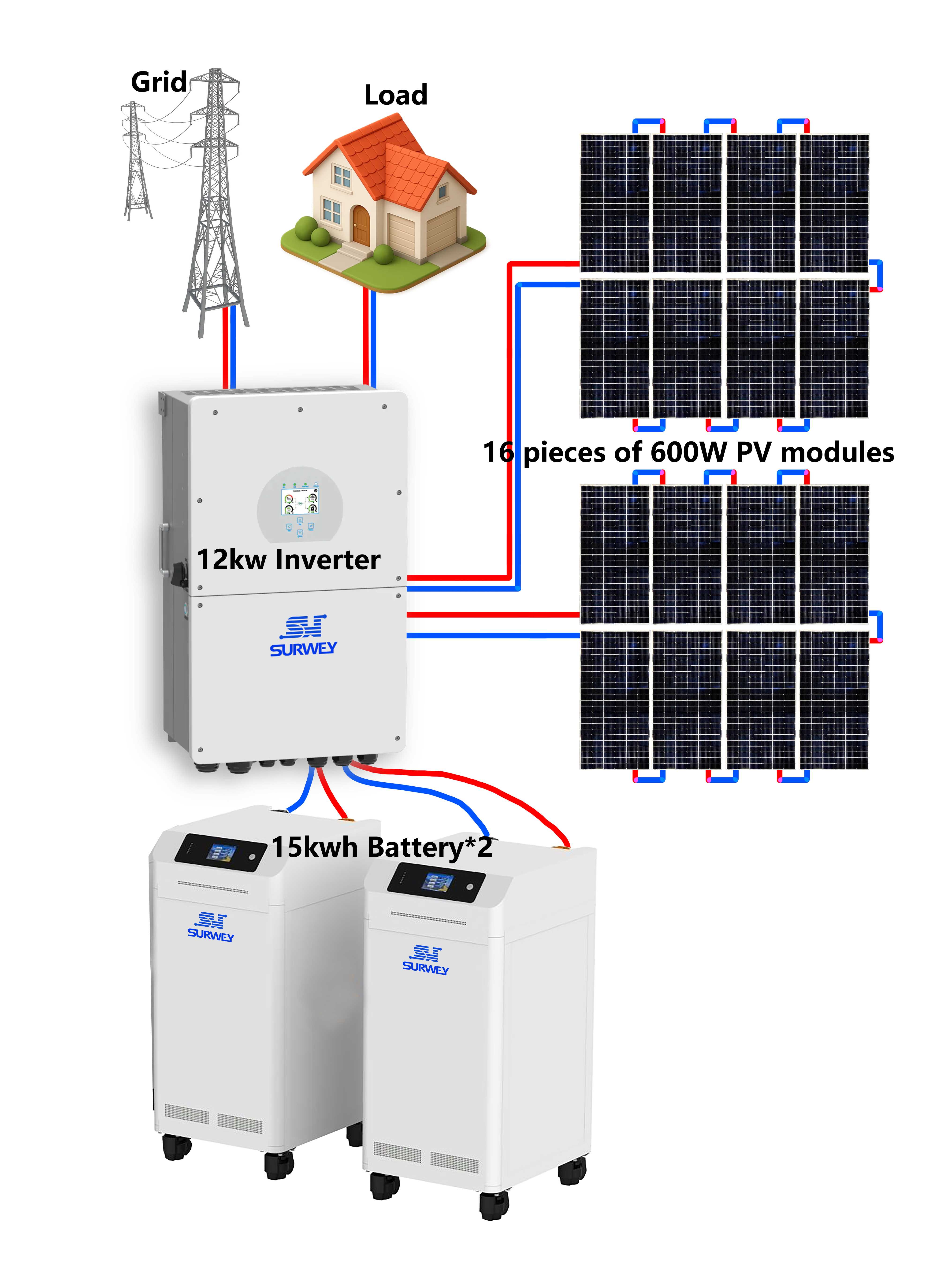
System Topology Diagram
The operating voltage and current of the two strings (8 modules in series each) fall within the normal MPPT operating range of the inverter. The open-circuit voltage and short-circuit current of the strings do not exceed the maximum allowable DC-side limits of the inverter. The DC-side electrical parameters are well matched, satisfying conditions for long-term safe and stable equipment operation without risks of inverter damage caused by overvoltage or overcurrent.
2. Main Equipment Parameters of the Project
600W PV Module
As the energy source of the system, the 600W high-power PV module converts solar energy into DC electricity. It is suitable for tropical high-temperature and high-irradiation environments, featuring excellent resistance to humidity, heat and hot spots, good corrosion resistance for outdoor application and stable power output, laying the foundation for photovoltaic power generation of the whole system.
12kW Hybrid Inverter

It serves as the core control and conversion device of the system, integrating MPPT solar charging, battery management and power inversion functions. It has 2 MPPT ports and 2 battery ports, high-level outdoor protection and complete AC & DC protection functions. Multi-period charge and discharge strategies are configurable. It supports external connection of diesel generators to directly charge batteries and parallel connection of multiple units for capacity expansion. With high overall conversion efficiency, it handles photovoltaic power, controls battery charge and discharge, and outputs AC power to loads to ensure uninterrupted power supply.
15kWh Mobile Low-Voltage Lithium Battery

Single unit specification: 51.2V / 300Ah, capacity 15kWh, cycle life ≥8000 times. Built-in BMS with multiple safety protections. Two units connected in parallel achieve a total storage capacity of 30kWh. The mobile structure enables flexible installation and relocation, with fast charge and discharge response, suitable for tropical industrial energy storage scenarios.
3. System Operation Principle
The system adopts an energy dispatch strategy: PV priority, energy storage for peak shaving, diesel / utility power as backup. Fully automatic operation is realized without 24-hour on-site personnel duty.
Schematic Video of System Wiring & Working Principle
☀ In daytime with sufficient solar irradiation: The 600W PV modules receive solar radiation and output DC power, which is transmitted to the 12kW hybrid inverter. The internal MPPT module tracks the maximum power point in real time. The electric power generated by PV is preferentially converted into AC power to supply various electrical equipment on site. When PV power output exceeds real-time load consumption of the workshop, surplus DC power charges the 15kWh lithium battery pack to store electric energy, achieving the target of 30kWh daily stored energy.
🌙 At dusk, night time or on cloudy/rainy days with insufficient solar irradiation: PV output drops sharply or stops completely. The system automatically switches operation mode. The lithium battery pack outputs DC power, which is inverted into standard grid-frequency AC power by the 12kW hybrid inverter to continuously supply power to workshop loads. When the battery state of charge drops to the preset protection threshold, the system triggers an alarm. Utility power can be connected to supply loads, or diesel generators can be started to recharge batteries, preventing system power outage caused by prolonged rainy weather.
The whole system is equipped with complete protection logic. In case of faults such as overvoltage, overcurrent, overheating and insulation abnormality, the equipment will automatically stop for protection and resume operation after faults are cleared, adapting to unattended operation of plantation workshop.
4. Available Load Power & Continuous Power Supply Duration
The maximum AC output power of the hybrid inverter is 12kW, capable of supplying loads including workshop lighting, security monitoring, ventilation fans and small auxiliary palm oil processing equipment. The system has 2 sets of 15kWh batteries connected in parallel with total capacity of 30kWh. Considering battery discharge depth limit and inverter conversion loss, the actual usable power for external power supply is approximately 24kWh.
The table below lists power rating, quantity, total power of common electrical equipment in the plant, as well as continuous operation duration under battery-only power supply (without PV supplement, powered solely by energy storage batteries):
| Electrical Equipment | Power per Unit | Quantity | Total Power | Continuous Runtime (Battery Only) | Function Description |
|---|---|---|---|---|---|
| Workshop LED Lighting | 100W | 8 pcs | 800W | ~30h | Workshop & warehouse lighting |
| Security Monitoring System | 150W | 2 sets | 300W | ~80h | Plant security camera & video recording |
| Workshop Ventilation Fan | 750W | 3 pcs | 2250W | ~10.6h | Workshop heat dissipation & ventilation, essential for tropical environment |
| Small Material Conveying Auxiliary Motor | 2200W | 1 set | 2200W | ~10.9h | Auxiliary equipment for simple palm oil raw material conveying |
| Office PC & Low-Voltage Devices | 500W | 1 set | 500W | ~48h | On-site duty office & data recording |
| Mixed Load Scenario 1 (Lighting + Monitoring + Fan) | - | - | 3350W | ~7.2h | Regular night duty loads of workshop |
| Mixed Load Scenario 2 (All equipment fully turned on) | - | - | 6050W | ~4.0h | Extreme short-time full load condition |
Notes:
- The above runtime values are theoretical calculation results under battery-only discharge without PV input. The actual runtime will increase significantly with PV power generation during daytime.
- The system maximum output is 12kW, allowing access to higher power short-time loads. However, total load for continuous operation is recommended to be controlled within 6kW to extend battery service life.
- When battery SOC reaches the lower protection limit, the system will automatically cut off non-critical loads while retaining power supply for monitoring and emergency lighting.
Under sunlight conditions in daytime, PV modules continuously generate power to supply equipment and recharge batteries simultaneously. The equipment can run all day without fully relying on battery capacity. In case of consecutive rainy days and battery depletion, utility power or diesel generators can be activated to guarantee uninterrupted power supply for critical equipment.
5. Conclusion
This PV-ESS system is specially designed for the weak power supply condition of remote palm oil plantation workshop in Sumatra. The voltage and current of PV strings are all within the allowable operating range of the inverter with reliable electrical matching. Equipment selection fully considers the local tropical climate of high temperature, high humidity and heavy rainfall, and the protection grade of the whole unit meets outdoor deployment requirements.
With designed daily power generation of 48kWh and daily stored energy of 30kWh, the system can cover most basic power demand of the workshop, effectively reduce startup frequency of diesel generators, cut fuel consumption and later-stage operation & maintenance cost, and lower carbon emissions. The energy storage battery achieves cycle life over 8000 times. Mobile batteries feature flexible layout, and equipment capacity can be further expanded according to future power consumption growth of the plant. The whole solution has high automation degree and supports unattended operation, satisfying actual power supply requirements of palm oil plantation workshop with good practicability and economic benefits.


